Coffee with clients


Smarter customer relationships
Transforming Healthcare with Stingo CRM & IVR Solutions
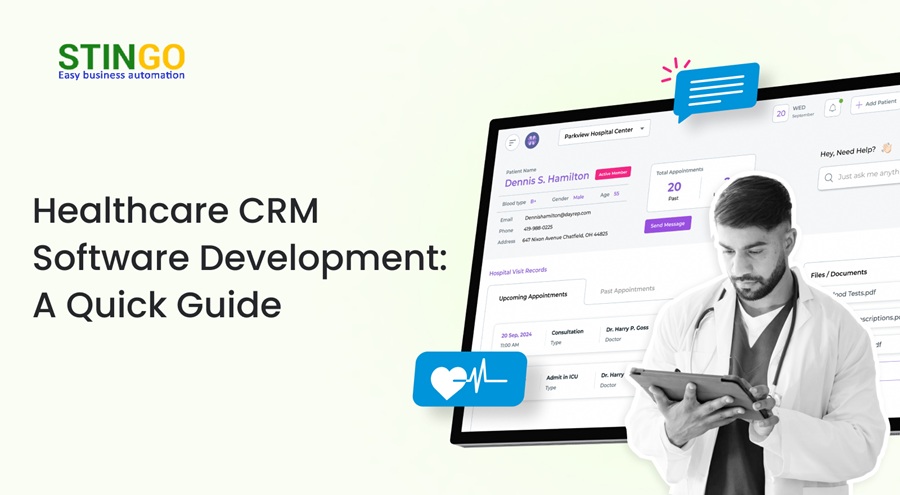
CRM Software healthcare-crm-solutions
Healthcare is changing fast. Everyone knows that. But managing it all patients, data, calls, appointments that where things start getting complicated.
Hospitals and clinics are not just about treatment anymore. There is a lot happening behind the scenes. Staff handling calls all day, patients waiting, data being entered again and again, it adds up.
This is exactly where tools like Stingo CRM and IVR come into the picture. Not some magic solution, but yeah, it definitely makes things easier if used properly.
What is Stingo CRM & IVR?
Lets not make it too technical.
Stingo CRM is basically a system where all patient-related information stays in one place. Instead of checking files, registers, or different software everything is just there. Simple.
Now IVR, you have used it already, even if you did not notice. When you call somewhere and hear:
Press 1 for appointments, press 2 for reports, that is IVR.
When both are connected, things start working smoother. Not perfect, but definitely better than manual chaos.
Key Challenges in Healthcare
Honestly, the problems are not always big, but there are too many small ones.

*	Calls coming non-stop, especially in busy hours

*	Patients waiting just to book an appointment

*	Staff repeating same information again and again

*	Data getting entered manually (and sometimes wrong too)

*	Follow-ups getting missed. which happens more often than people admit

Individually these do not look serious. Together? It slows everything down.
How Stingo CRM Helps Healthcare Providers
1. Centralized Patient Data Management
Earlier, finding patient history could take time. Sometimes files, sometimes systems, not very organized.With CRM, its all in one place. You search, you get it.
Less confusion.Less back and forth.
And yeah, fewer mistakes too (not zero, but less).
2. Smart Appointment Scheduling
Booking appointments sounds simple, but in reality, its not always.Double bookings happen. Time slots overlap. Patients call again just to confirm.
With CRM + IVR, patients can book or reschedule on their own. Staff does not have to handle every single call.
It saves time. For everyone.
3. Automated Follow-Ups and Reminders
This is one area where things usually slip.Patients forget. Staff gets busy. Follow-ups missed.
Automation helps here. Messages or calls go automatically, reminders for visits, medicines, whatever is needed.
Not perfect, but definitely more consistent than manual tracking.
4. Enhanced Patient Engagement
When a hospital remembers your last visit or details, it feels different.CRM keeps track of interactions. So communication becomes a bit more personal, not just random.
Does it build trust? Yeah, over time it does.
Role of IVR in Healthcare Efficiency
1. 24/7 Patient Support
Hospitals dont really close, but staff availability is still limited.IVR does not have that issue. It works anytime.
Patients can get basic info without waiting for someone to pick up the call. Simple things, but useful.
2. Call Routing & Reduced Wait Time
Getting transferred multiple times on a call, honestly, very frustrating.IVR reduces that. It sends calls to the right department directly (most of the time).
Less waiting. Less irritation.
3. Multilingual Support
Not everyone is comfortable in one language. That is just reality.IVR can offer options. Different languages. Makes things easier for patients to understand.
Especially in a country like India, this matters a lot.
4. Emergency Handling
In urgent cases, delay is a problem.IVR can prioritize certain calls, so emergencies do not get stuck in normal queues.
Its a small feature, but important.
Integration Benefits: CRM + IVR
Now this is where things actually start making more sense.
When IVR and CRM are connected, data flows automatically. No need to enter everything again.
Also, you get insights, like how many calls are coming, what patients are asking, where delays happen.
Not everyone uses this data properly, but if they do, it helps improve things.
Overall, less manual work. More focus on patients. That is the idea.
Use Cases in Healthcare
Hospitals
Big setups, lots of patients. Managing everything manually? Difficult.CRM and IVR help in handling appointments, calls, and coordination better.
Clinics
Smaller teams, limited staff. Still same challenges.These tools help them stay organized without needing too many people.
Diagnostic Centers
People keep calling for reports. Again and again.IVR can handle these queries without involving staff every time. Saves effort.
Telemedicine Providers
Online consultation is growing. Fast.Here, automation is almost necessary. Booking, reminders, follow-ups, everything can be managed easily.
Security and Compliance
Patient data is sensitive. No compromise there.Stingo CRM provides controlled access. Not everyone can see everything.
Data stays secure (as much as system allows), and that is important for trust.
Why Choose Stingo CRM & IVR? 1.	Not too complicated to use

2.	Works for both small and large setups

3.	Can be customized as needed

4.	Reduces repetitive work

5.	Support is there if things go wrong

Nothing fancy, just practical benefits.
Healthcare is already a demanding field. Managing operations along with patient care is not easy.
Stingo CRM with IVR does not solve everything. But it does make things smoother. Less chaos, more structure.
And in the long run, that matters.
Better systems ? better management ? better patient experience.