
Coffee with clients
Which Is Best CRM for B2B? A Complete Crm Guide for Businesses
CRM Software best-crm-software-for-b2b
Which Is Best CRM for B2B? A Complete Guide for Business Crm
Choosing the best CRM for B2B can make a real difference in how a business manages leads, follows up with customers, and closes deals. Many companies receive enquiries through websites, emails, phone calls, and social media, but keeping track of all these leads is not always easy.
This is where best CRM software becomes useful.
There are several CRM platforms available today, including HubSpot, Salesforce, Zoho CRM, and Pipedrive. Each has its own strengths. Some are better for large organizations, while others are more suitable for small and medium-sized businesses.
So, which CRM is best for B2B sales? The answer depends on your business requirements, sales process, team size, and budget. Let's look at the available options and what you should consider before making a decision.
What Is Best B2B CRM?
A B2B CRM (Business-to-Business Customer Relationship Management) is software that helps companies manage their relationships with other businesses. It stores important information about customers, prospects, sales opportunities, and previous conversations in one place.For example, a manufacturing company may receive enquiries from distributors, wholesalers, contractors, and corporate buyers. Without a proper system, the sales team may find it difficult to remember who requested a quotation or which customer needs a follow-up.
A CRM helps organize these activities. Sales representatives can check customer details, update deal status, schedule calls, and see what needs to be done next.
In simple terms, it helps businesses manage sales in a more organized way instead of depending entirely on spreadsheets and manual reminders.
Which CRM Is Best for B2B Businesses?
There is no single CRM that works best for every company. A small business with three sales representatives may have very different requirements from a large organization managing hundreds of sales opportunities.Here are four popular CRM platforms worth considering.
CRM software	Best for	Main advantage

1. HubSpot CRM	Growing businesses	Connecting sales and marketing

2. Salesforce	Large organizations	Advanced customization

3. Zoho CRM	Small and medium-sized businesses	Broad functionality and automation

4. Pipedrive	Sales-focused teams	Easy-to-follow sales pipelines
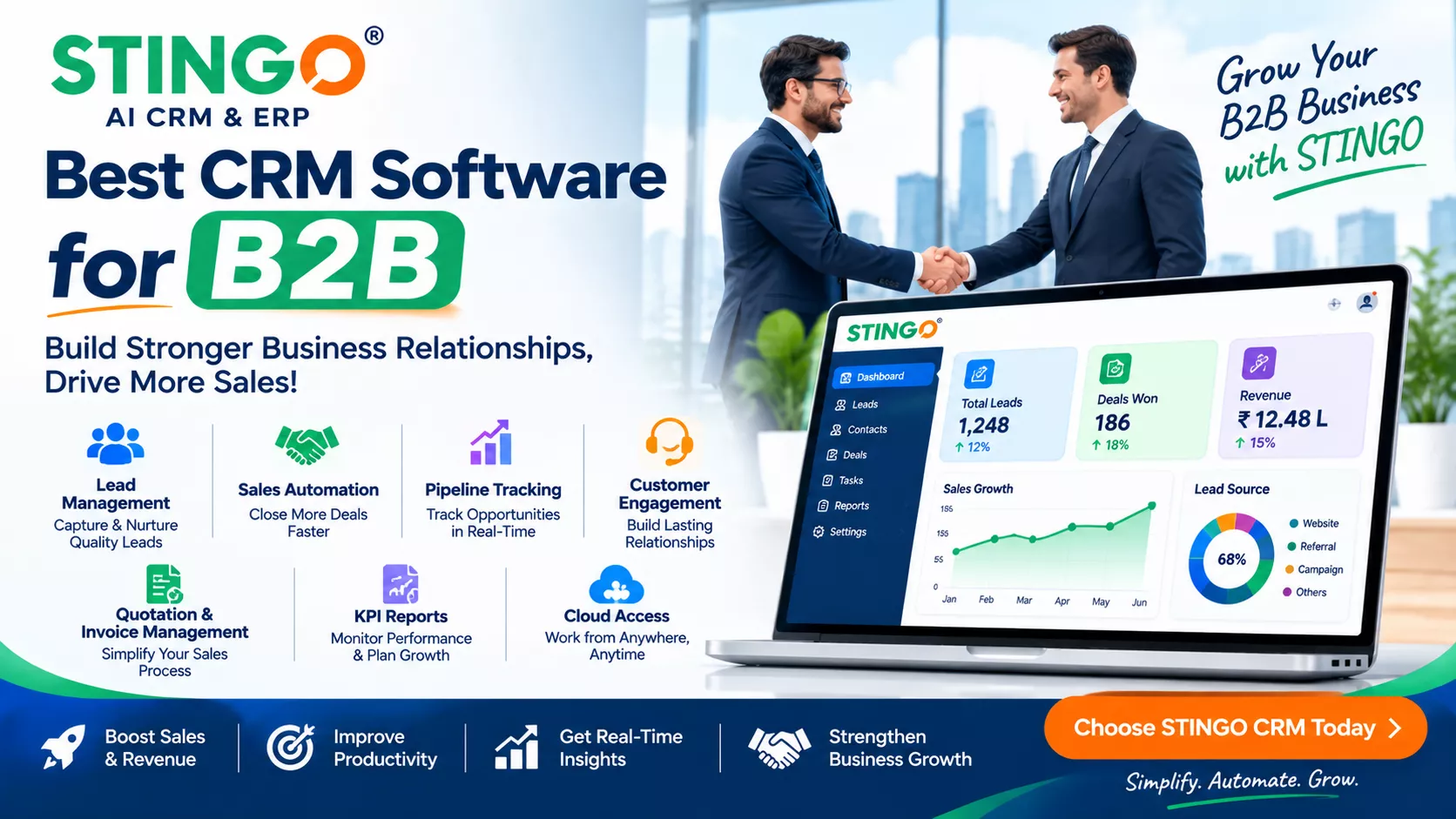
Stingo CRM is another option businesses can explore when comparing solutions for sales management. Its suitability should be assessed against the features and workflows your company needs.
1. HubSpot CRM
HubSpot CRM is a popular choice for businesses that want to manage sales and marketing activities together. It provides tools for organizing contacts, tracking deals, and monitoring interactions with potential customers.One useful aspect is its connection between marketing and sales. Businesses that generate leads through SEO, content marketing, and online campaigns may find this helpful.
Key features include:
1. Contact and company management
2. Sales pipeline tracking
3. Email tracking and sales tools
4. Reporting and dashboards
5. Marketing automation options
However, advanced features may require paid plans. As the business grows and needs more functionality, the overall cost can increase.
HubSpot is worth considering for B2B service providers, software companies, and businesses that depend on online lead generation.
2. Salesforce
Salesforce is designed to support a wide range of customer relationship and sales management requirements. It is particularly popular among larger businesses with complex sales processes.Companies can manage accounts, track opportunities, create customized workflows, and generate reports to understand sales performance.
Its flexibility is a major advantage. A business can configure the system around its internal processes, although this may require technical knowledge or professional implementation support.
For smaller teams, Salesforce may feel more complex than necessary. Costs and administration requirements should also be considered before selecting it.
Best suited for: Enterprises and businesses with large sales teams, multiple departments, and complex customer management needs.
3. Zoho CRM
Zoho CRM is another option for companies looking for a flexible customer management platform. It offers tools for lead tracking, sales automation, reporting, and managing customer interactions.For example, a distributor can use CRM software to organize enquiries, assign leads to sales representatives, and track opportunities from the first conversation to the final order.
Zoho CRM also offers customization options, allowing businesses to adjust certain fields and workflows according to their needs.
The platform has a broad range of features, though some users may need time to learn how everything works. It is a good idea to test the system before moving all your customer data into it.
Best suited for: Small and medium-sized businesses, distributors, consultants, and growing B2B companies.
4. Pipedrive
Pipedrive takes a sales-focused approach to CRM. Its visual pipeline helps sales representatives see which deals are progressing and which ones need attention.Imagine having 40 active business enquiries. Some customers are waiting for quotations, others are negotiating prices, and a few have not responded to your calls. A sales pipeline makes it easier to track these opportunities without going through multiple spreadsheets.
Pipedrive also offers activity tracking, reminders, reporting, and automation features, depending on the plan.
Its main focus is sales pipeline management. Businesses that need more extensive marketing or enterprise functionality should check whether additional tools are required.
Best suited for: B2B sales teams, consultants, agencies, and companies that want a clear view of their sales opportunities.
Important Features to Look for in B2B CRM Software
Before selecting a CRM, think about the problems your sales team faces every day. A platform with hundreds of features may not be useful if the team finds it difficult to use.Here are some important capabilities to consider.
Lead Management
Lead management is one of the most important functions of a B2B CRM. It helps businesses collect and organize enquiries from different sources, including website forms, advertising campaigns, emails, and phone calls.A well-organized lead database also makes it easier to assign enquiries to the right salesperson and track their progress.
Contact and Company Records
B2B sales often involve several people from the same organization. A CRM should help you maintain company details, contact information, communication history, and notes about customer requirements.This becomes particularly useful when a deal takes several weeks or months to close.
Sales Pipeline Tracking
Every business has its own sales process, but most B2B companies move through similar stages.For example:
I. New enquiry
II. Initial contact
III. Lead qualification
IV. Meeting or product demonstration
V. Quotation shared
VI. Negotiation
VII. Deal won or lost
A CRM helps the team understand where each opportunity stands. Managers can also identify deals that have been sitting at the same stage for too long.
Follow-Up Reminders
Sometimes, a potential customer is interested but not ready to purchase immediately. If the salesperson forgets to follow up, the opportunity may be lost.CRM software can help schedule calls, meetings, and reminders so that important enquiries do not get overlooked.
Reporting and Sales Analytics
Sales reports help businesses understand what is working and where improvements are needed.You may want to track the number of leads generated, conversion rates, average deal value, sales cycle length, and performance by lead source.
These insights can support better decisions about sales activities and marketing expenditure.
Automation and Integrations
Automation can reduce repetitive work, such as assigning leads, creating follow-up tasks, or sending internal notifications.Integrations are equally important. Check whether the CRM connects with the tools your team already uses, such as email, website forms, accounting applications, telephony, and advertising platforms.
Remember that integration availability may vary by CRM and subscription plan.
How to Choose the Best CRM for Your Business
Selecting a CRM is not just about comparing features or choosing the most popular name. You need a platform that fits your actual sales process.Start by identifying what your team wants to improve. Is it lead management, follow-ups, reporting, or communication between sales representatives?
Next, consider the budget. Apart from the monthly subscription, there may be expenses for onboarding, integrations, customization, and staff training.
It is also important to check ease of use. If a CRM takes too much time to update, sales representatives may avoid using it regularly. That can lead to incomplete data and unreliable reports.
Before making a final decision, try the CRM with a few sample leads. Create a sales pipeline, assign tasks, update deal stages, and generate a report. This simple exercise can tell you more than a long feature comparison.
Finally, think about future requirements. The software should be able to support your business as the number of customers, sales representatives, and opportunities increases.
What Is the Best CRM for B2B?
Complete Guide for B2B Sellers Which CRM is best for B2B? Choosing the right CRM for B2B can influence how a business manages its sales leads, contacts, customer follow-ups, and sales pipeline. Many firms receive enquiries via their websites, by email, phone, or social media, but the management of these leads is not always straightforward.This is the reason companies turn to CRM software solutions.
There is a wide range of CRM tools available in the market, including the likes of Hub Spot, Salesforce, Zoho CRM, and Pipedrive. Each software has its advantages and disadvantages, some are suitable for larger organizations, while others work better for small or medium-sized firms.
What is the best CRM for B2B sales?
It depends on your sales process, sales team size, budget, and business needs. Here is a list of available options and what you should consider before making a choice.What Is a B2B CRM?
A B2B CRM (Business-to-Business Customer Relationship Management) is a piece of software that enables firms to keep track of their relationships with other companies, manage prospects and sales opportunities, and record interactions with their contacts.As an example, a manufacturing firm may work with wholesalers, distributors, contractors, and corporate buyers. Keeping track of enquiries can prove difficult without a system in place.
A CRM provides a level of automation and helps sales teams organize their activity. Users of the system can search for customer details, update the status of existing opportunities, and organize and schedule sales calls and other activities.
Basically, it offers a more organized approach to managing sales rather than relying solely on spreadsheets and appointment reminders.
Which CRM Is Suitable for B2B? There is no one-size-fits-all solution when it comes to a CRM tool for B2B. The sales process at a small enterprise with three sales reps will probably be very different from a larger organization, which manages hundreds of opportunities.
Here are four popular CRM platforms to consider:
CRM software Best for Main benefit
Hub Spot CRM Growing organizations Connecting sales and marketingSalesforce Large companies Advanced customization
Zoho CRM Small and medium-sized firms Functionality and automationPipedrive Active sales teams Sales pipeline management
Another option for B2B firms is Stingo CRM, which should be considered based on its features as compared with your sales and customer management process.
1. Hub Spot CRM
Hub Spot is a CRM for companies wanting to combine sales and marketing management tools. It enables businesses to organize contacts and companies, manage deals, and track interactions with potential customers.For example, a B2B service provider, software vendor, or online seller that acquires traffic through SEO or paid campaigns may find this helpful.
Main features:
Contact and company management
Sales pipeline monitoring
Email tracking and sales tools
Dashboards and reporting
Marketing automation tools
Some advanced tools are only available to those on a paid plan. As the business expands and requires additional functionality, the cost can increase.
Hub Spot could be suitable for online service providers, B2B software firms, and those that generate large volumes of online traffic.
2. SalesForce
Salesforce offers a host of CRM features suitable for a wide range of client management and sales processes. It is popular among larger B2B firms with many opportunities to pursue.It enables the business to manage different customers, monitor deals, create reports, and implement customized workflows.
The main benefit of the Salesforce platform is the ability to tailor it to the firm's needs, although a technical backup is often recommended.
It may feel a little large for a small sales team, and the costing structure and admin overhead should be understood in the context of CRM requirements.
Best fit: Large firms and B2B entities with complex customer management requirements and many sales reps.
3. Zoho CRM
Zoho has many benefits for a company looking for a flexible CRM platform. It offers automation, lead management, report building, customer interaction management, and sales force automation.A distributed business, for example, a wholesaler or distributor, could utilize the tool for managing enquiries, assigning leads to internal salespeople, and tracking opportunities through to a sale.
There are many options for customizing what a user sees and how workflows are set up.
The CRM has many features, but some users may take a little time to understand it. For example, starting a new database and importing existing client details should be done with care.
Suitable for: Small or medium-sized B2B firms, service providers, and companies that work with distributors or consultants
.
Introducing Stingo CRM for B2B Sales Management
Different businesses will need different things from a CRM platform. Some will want advanced automation and deep customization, while others will simply want a simple solution that helps them organize their leads and customer relationships and keeps track of their sales.This is why it pays to look at some of the different options that are available.
You might like to consider Stingo CRM as a potential solution. Companies interested in improving their sales management process can explore its offering and assess how well it fits their daily requirements.
Before you decide to go with Stingo CRM, think about whether the system's available features will provide the leads management, contact organization, sales tracking, follow-up, reporting, and integration capabilities you need.
A CRM should not be something that you buy but something that your team will be able to use regularly without creating more complexity in their working days.
You can learn more about Stingo CRM on the website: https://www.stingosales.com/
If you are currently comparing CRM platforms for your B2B company, make sure that you add this option to your list and compare the features, price, and usability.
Why B2B Companies Should Use CRM Software
Many businesses still keep their customer data on Excel spreadsheets, in email inboxes, or on the call logs of individual salespeople. This can work in the short term but gets harder to manage once a business starts to grow.
CRM provides a system that everyone on the team can access to find the right customer information.
CRM can help improve the consistency of follow-up, simplify the tracking of sales leads, and help managers monitor the performance of their team. It can also make it easier to carry on a conversation with a customer if the account needs to be taken over by a different team member.
For manufacturers and distributors, CRM software can provide an effective way to track quotations, follow up on repeat enquiries, and work with business customers.
Installing CRM software will not guarantee the sales rise, the best results come if the team uses the new system consistently and if the sales process is being effectively managed.